

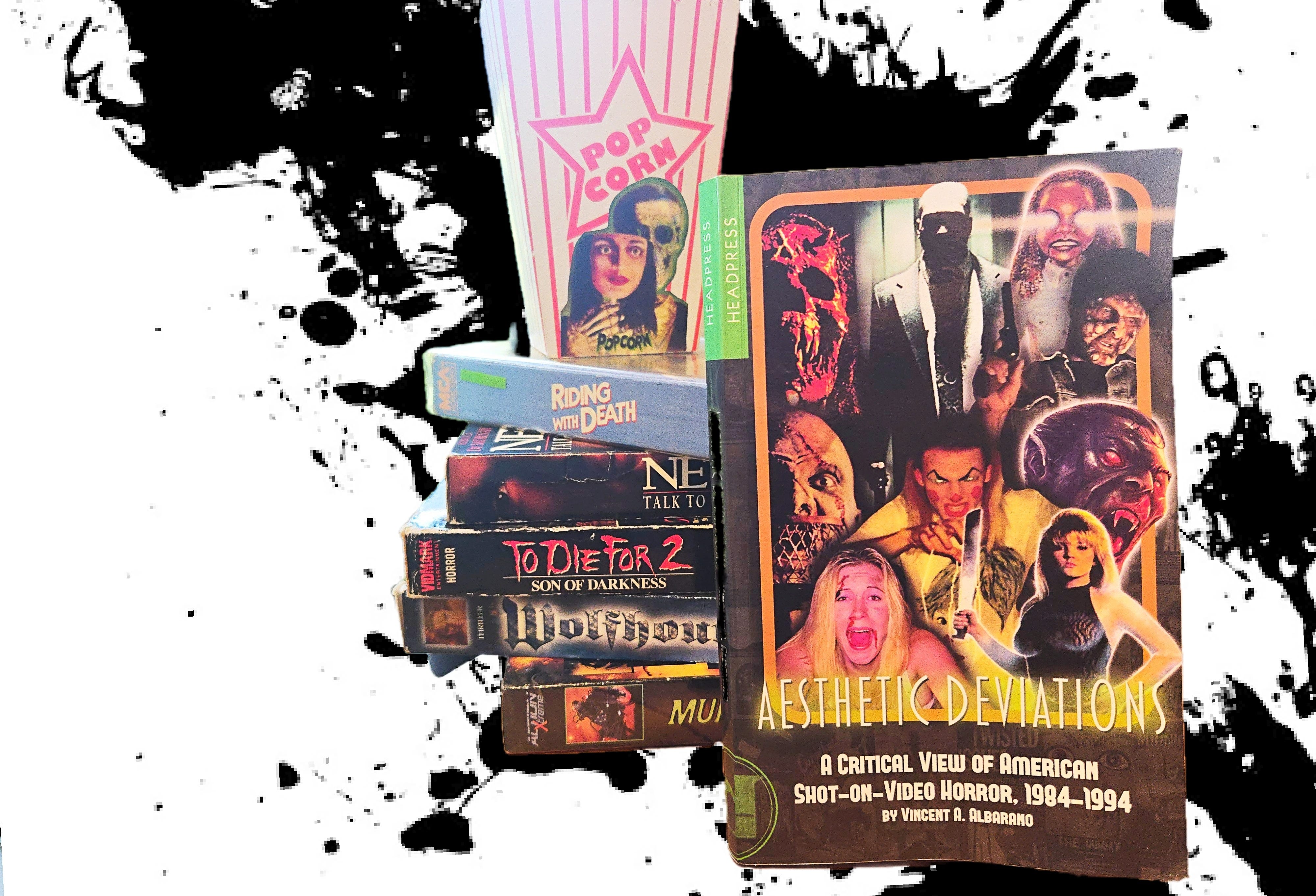
(BOOK REVIEW) Aesthetic Deviations: A Critical View of American Shot-On-Video Horror, 1984-1994
Vincent Albarano's book finds artistic value in the rough edges of shot-on-video horror.

Shot-on-video horror has long occupied an awkward place in film culture. Too crude for traditional criticism, too strange for mainstream nostalgia, it often gets discussed as a curiosity rather than a body of art. In Aesthetic Deviations, Vincent A. Albarano argues that the American shot-on-video cycle (1984–94) deserves critical attention as a form of amateur creative expression.1 Through close readings and historical analysis, he builds a case for the cycle’s aesthetic legitimacy from a variety of critical perspectives.
The book is accessible enough to appeal to anyone open to DIY and amateur filmmaking as art. One word Albarano borrows from Stan Brakhage to describe SOV films is “honest,” and the same quality defines his approach. His even-handedness is refreshing, though it occasionally means bracketing some of the meatier questions. Beyond filling a genuine gap in the literature, Aesthetic Deviations offers valuable insights for anyone writing about amateur cinema.
In the first chapter, “Amateur Cinema and the Dawn of Shot-on-Video Horror,” Albarano surveys the history of SOV horror and its academic and popular reception. He distinguishes his approach from V. Vale’s emphasis on “pure enjoyment and delight,” noting that the genre contains both weak films and troubling politics.2 Likewise, he argues that frameworks such as Jeffrey Sconce’s paracinema and Stephen Thrower’s anti-semiosis can be overly ironic, obscuring the legitimate artistry at work.3
In “Demon Dolls & Quadead Zones: Amateur Cinephilia and the Alternative Function of Realism,” Albarano examines Chester N. Turner’s Tales from the Quadead Zone and Todd Cook’s Demon Dolls. Drawing on Siegfried Kracauer and André Bazin, he argues that the limitations of SOV filmmaking create an unconventional form of cinematic realism. When the actors are friends and the set is someone’s house, the films begin to function like home movies. Stripped of polished montage, our attention shifts to “interstitial moments, small gestures, peculiarities of individuals and places.”4
“Todd Sheets and SOV Medium Specificity” traces the career of Kansas City filmmaker Todd Sheets to argue for analog video’s democratizing potential. Technical limitations and institutional exclusion, Albarano suggests, can gradually become the basis of a distinct artistic identity.
In “SOV Horror and the Unexpected Avant-Garde,” Albarano demonstrates how amateur filmmakers appropriate avant-garde techniques, transforming limitations into creative possibilities. The chapter contains an excellent reading of Charles Pinion’s Twisted Issues through the lens of P. Adams Sitney’s theories of lyrical and trance films, with comparisons to Maya Deren’s Meshes of the Afternoon.5 Albarano also examines Alan Sukenick’s Alien Beasts through the framework of Brakhage’s lyrical works.
In “Splatter Video: Mutating the Slasher Film,” Albarano explores how the Polonia Brothers’ Splatter Farm twists slasher conventions by redirecting violence toward men.
“Excess & Outrage: The Transgressive Video Underground” turns to films that seek disturbance for its own sake, drawing on Arthur C. Danto’s concept of “disturbational art.” The chapter focuses primarily on Black Devil Doll, Joe Christ, and Pinion’s Red Spirit Lake. Once again, the discussion of Pinion’s work stands out.
In “Underground Economies: SOV Reception in the 2020s,” Albarano provides an overview of the contemporary SOV revival, covering the various impulses toward collecting, archiving, preservation, and nostalgia.
For me, the best criticism is not necessarily the most rigorous or defensible. It is the criticism that articulates the encounter with art, taking it out of a black box and into the light. It helps me to see more in everything. Through Bazin, Kracauer, Sitney, and Brakhage, Aesthetic Deviations achieves that effect. I found myself double-underlining, scribbling asterisks, and setting the book down to let an idea sink in. Yet I also felt the analysis occasionally hedged where it had the grounds to be bold. Admittedly, that is a difficult balance when writing a book that aims to reach beyond die-hard SOV fans.
One area where I wanted deeper engagement concerns violence, transgression, and gender. At times, Albarano treats the misogyny of certain films as a settled question. Many readers will appreciate that moral clarity. Still, I found it a missed opportunity. Feminist critics have repeatedly shown that seemingly exploitative films can sustain more complicated interpretations.6 Red Spirit Lake may invite critical recuperation more readily than Video Violence, but context still matters, including who is watching and why. The relationship between women and horror spectatorship has always been more complicated than it appears. Amateur production in particular gets accused of being gratuitous simply for not having the resources to aestheticize violence the way a conventional arthouse picture might.
If art is to matter at all, it must matter when it is made without money, prestige, or professional infrastructure. It must matter when the actors are friends, the locations are borrowed, and the equipment is whatever happens to be available. Otherwise, we are not really talking about art. We are talking about access. If you share my passion for amateur expression and wish you had more nuanced ways of understanding and communicating its value, I strongly recommend purchasing and reading Aesthetic Deviations.
You can purchase a copy here, and check out some of his writing on Split Tooth and Bright Lights Film Journal.
Albarano, Vincent A. Aesthetic Deviations: A Critical View of American Shot-on-Video Horror, 1984–1994. Manchester: Headpress, 2023
Vale, V., and Andrea Juno, eds. RE/Search #10: Incredibly Strange Films. San Francisco: RE/Search Publications, 1986.
I would have enjoyed a more point-by-point rebuttal of these theories as illuminated by SOV, instead of peppering critique throughout, but that’s my sick and twisted rhetoric background.
Thrower, Stephen. Nightmare USA: The Untold Story of the Exploitation Independents. Godalming, Surrey: FAB Press, 2007.
Sconce, Jeffrey. “‘Trashing’ the Academy: Taste, Excess, and an Emerging Politics of Cinematic Style.” Screen 36, no. 4 (Winter 1995): 371–93.
Ibid. 1. p. 45.
Another great application of Sitney is in Albarano’s essay on Nathan Schiff’s Vermillion Eyes at Bright Lights Film Journal.
For example, I really like Linda Williams 1991 “Film Bodies: Gender, Genre, and Excess” (1991) for bodily excess as politically and aesthetically meaningful, especially in genres that mainstream criticism often dismisses as gratuitously exploitative. But I’m also someone that will go on the record to defend Baise-Moi.